







Permaculture & Biodiversity in Townships: From Amenity to Ecosystem Service
By May each year, large parts of North and Central India begin to simmer. In 2022, several cities recorded temperatures crossing 45°C, with the India Meteorological Department noting prolonged heatwave conditions across multiple states. The pattern is not episodic. The Intergovernmental Panel on Climate Change, in its Sixth Assessment Report, highlights that South Asia is witnessing a measurable escalation in extreme heat events, with hotter days occurring more often and lasting longer than in previous decades. What was once considered exceptional is gradually becoming seasonal.
Yet within the same cities, temperature variations of 2–5°C can exist between heavily built-up zones and tree-covered areas. A study by TERI (The Energy and Resources Institute) has documented the urban heat island effect in Indian metros, showing how dense construction and low vegetation amplify surface temperatures (TERI, “Urban Heat Island Assessment”).
For real estate developers planning integrated townships, this is no longer a landscaping issue. It is infrastructure.
The question is no longer how green a project looks, but how intelligently it performs.
Rethinking Permaculture in an Urban Context
Permaculture is often misunderstood as small-scale farming. In reality, as articulated by its co-founder Bill Mollison, it is a design philosophy rooted in observing natural systems and replicating their efficiencies. Applied to townships, permaculture is about integrating water, soil, vegetation, and built form into a coherent ecological network rather than treating them as separate amenities.
In the Indian context, this means designing with climate, not against it. It means choosing native species adapted to agro-climatic zones defined by the Indian Council of Agricultural Research (ICAR). It means planning water flows before drawing roads. It means layering canopy, shrub, and ground cover in a way that mirrors natural forests.
Instead of isolated lawns and ornamental palms, permaculture-driven planning produces self-sustaining systems: shaded pedestrian networks, rain-fed landscapes, pollinator habitats, and soil that improves over time.
The shift is philosophical, but the outcomes are measurable.
Biodiversity Corridors: Connecting What Cities Fragment
Urbanisation fragments habitats. According to the UN Environment Programme (UNEP), urban expansion is among the leading causes of biodiversity loss worldwide (UNEP Global Environment Outlook). India is no exception. As per the India State of Forest Report 2021 by the Forest Survey of India (FSI), while overall forest cover has marginally increased, urban tree cover remains inconsistent and often disconnected.
Township-scale planning presents a rare opportunity: instead of fragmented patches, developers can create biodiversity corridors.
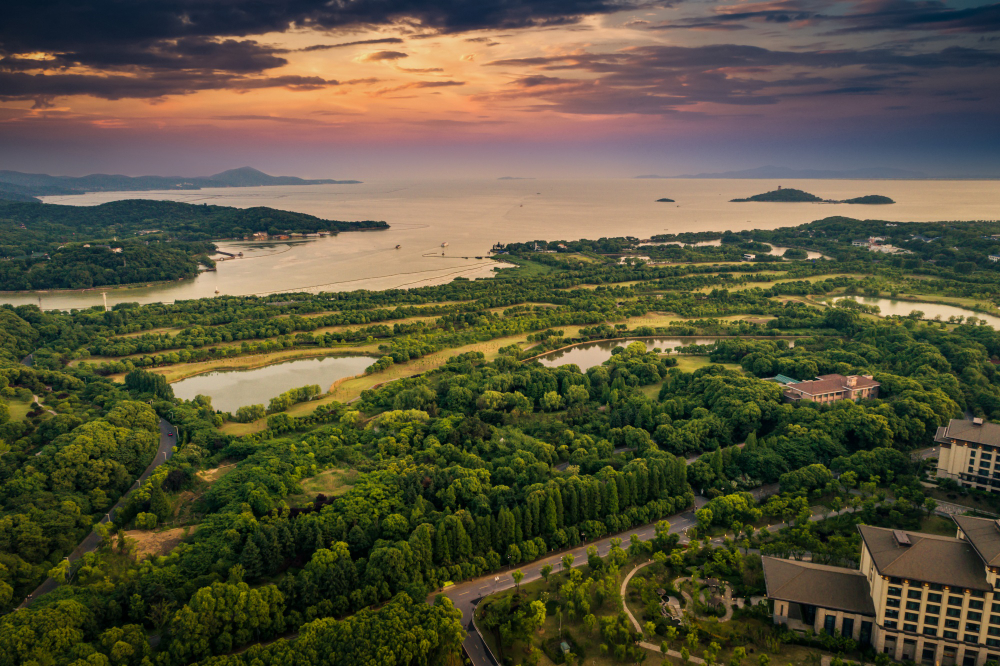
A corridor is not a park. It is a connected ecological spine. Tree-lined boulevards, riparian buffers along drainage channels, native shrub belts along compound edges, and wetland zones that link water bodies — together these create movement pathways for birds, insects, and small fauna.
Connectivity between green pockets carries tangible environmental value. According to the Food and Agriculture Organisation’s work on urban forestry, diverse plant and habitat systems within cities enhance ecological stability by enabling pollination pathways and natural pest control. For township design, this translates into landscapes that function as living systems rather than decorative buffers.
For a township, biodiversity corridors are not ornamental. They are functional systems that stabilise ecological performance.
Microclimate Engineering Through Ecology
Microclimate regulation is one of the most tangible ecosystem services. Vegetation cools through shade and evapotranspiration. According to research by IIT Delhi, tree-covered zones in Delhi can record significantly lower surface temperatures compared to adjacent built-up areas (IIT Delhi Urban Climate Studies).
Globally, the IPCC confirms that urban greening reduces heat stress and enhances thermal comfort.
Water bodies amplify this effect. The National Institute of Hydrology (Roorkee) notes that large water bodies moderate temperature fluctuations by absorbing and slowly releasing heat. In township design, integrating lakes, retention ponds, and bioswales is not an aesthetic indulgence — it is passive thermal management.
Well-designed street tree canopies can reduce surface temperatures by several degrees. Strategically placed shaded pedestrian paths can reduce radiant heat exposure. When combined, these interventions reduce dependence on mechanical cooling, indirectly lowering energy consumption.
Soil, Water & Carbon: The Invisible Infrastructure
Most master plans focus on what is visible — roads, towers, amenities. Permaculture begins below ground.
Healthy soil is a carbon sink. The FAO recognises soil as one of the largest terrestrial carbon reservoirs. Urban construction often strips topsoil and replaces it with compacted fill, destroying its ecological function.
A permaculture-led township retains and regenerates soil. Composting organic waste, reducing chemical fertiliser use, and preserving microbial life enhance long-term fertility and water retention.
Water-sensitive urban design is equally critical. India faces mounting water stress; the NITI Aayog Composite Water Management Index (2018) warned that 21 Indian cities could face groundwater depletion. Rainwater harvesting, contour-based swales, permeable pavements, and recharge wells can significantly reduce runoff.
The “sponge city” approach, promoted globally and referenced by the World Resources Institute (WRI) in its urban water resilience work, emphasises absorbing rain where it falls. Townships are uniquely positioned to implement this at scale.
Native Planting vs Decorative Landscaping
Ornamental lawns dominate Indian residential projects. They are water-intensive and ecologically shallow.
The Central Groundwater Board (CGWB) has repeatedly highlighted groundwater over-extraction in several Indian states. Lawns, particularly in semi-arid regions, require continuous irrigation and chemical inputs.
Native species, by contrast, are climate-adapted and require less maintenance once established. They support pollinators, birds, and local food chains. The National Biodiversity Authority of India emphasises the importance of conserving indigenous species to maintain ecological balance.
Replacing monoculture lawns with layered native planting reduces water use, improves soil stability, and enhances biodiversity — while lowering long-term maintenance costs.
This is not about abandoning aesthetics. Native landscapes, when thoughtfully curated, offer seasonal variation, texture, and ecological depth that decorative lawns cannot.
A Financial Comparison
The reliance on exotic species—like the Mexican Fan Palm or Korean Grass—is a fiscal drain. These species have high water requirements and provide almost zero support for local pollinators.
A study highlights that native species are far better at surviving the "extreme weather swings" now common in the Indian subcontinent. For a developer, this translates into lower replacement costs and a more robust landscape that thrives during droughts.
Measuring Ecosystem Services
To move from rhetoric to credibility, developers must quantify impact.
Thermal Regulation: Tree canopy coverage targets — often recommended at 30–40% in urban planning guidelines globally — can significantly reduce heat absorption.
Air Quality Improvement: The Central Pollution Control Board (CPCB) tracks particulate pollution in Indian cities. Vegetation can capture particulate matter on leaf surfaces, contributing marginal but meaningful reductions at micro-scale levels.
Noise Buffering: Studies in environmental acoustics show that vegetative buffers can reduce noise levels by several decibels when adequately layered.
Stormwater Management: According to WRI, green infrastructure reduces peak runoff and the risk of urban flooding.
These are not abstract benefits. They influence comfort, resilience, and operational efficiency.
Practical Implementation for Developers
Ecological Baseline Study: Before finalising the masterplan, assess soil health, existing vegetation, water flow patterns, and local fauna.
Native Species Palette: Align planting strategy with regional agro-climatic data (ICAR zones).
Integrated Water Strategy: Combine rainwater harvesting, bioswales, recharge pits, and constructed wetlands.
Canopy Coverage Targets: Define measurable green cover percentages in the planning stage.
Long-Term Biodiversity Management Plan: Landscaping contracts should prioritise ecological health, not just mowing cycles.
Monitoring & ESG Reporting: Track water savings, carbon sequestration estimates, and biodiversity indicators for transparency.
Without monitoring, sustainability claims collapse into marketing.
Financial & Brand Implications
Sustainability is no longer a fringe concern. According to JLL India’s Sustainable Real Estate reports, green-certified buildings often command rental and capital value premiums. Knight Frank India has similarly highlighted growing investor preference for ESG-aligned assets.
For township developers, biodiversity-driven planning offers differentiation beyond façade design. It signals resilience, lower operating costs, and long-term regulatory alignment.
As climate risks intensify, projects designed with ecological intelligence are likely to outperform those dependent on energy-heavy mitigation strategies.
Brand value increasingly aligns with environmental credibility.
Indian Case Signals
Cities such as Chennai have implemented Miyawaki-style urban forests in public spaces, accelerating dense native planting to restore biodiversity. Telangana’s Haritha Haram initiative aims to increase green cover statewide.
Delhi Ridge Restoration: The restoration of the Neela Hauz Biodiversity Park transformed a sewage-infested lake into a self-cleansing ecosystem, proving that nature-based solutions can outperform engineered ones at a fraction of the cost.
While these are public initiatives, township developers can implement similar logic in private master plans.
Designing for the Next 50 Years
Landscaping budgets are often the first to be rationalised in value engineering. That approach is shortsighted.
In a country confronting heat stress, water scarcity, and air pollution, ecological design is no longer cosmetic. It is risk mitigation.
Permaculture and biodiversity corridors transform green areas from passive décor into active infrastructure. They cool the air, manage water, enrich soil, support species, and strengthen brand identity.
For Indian townships aspiring to lead rather than follow, the real competitive edge may not lie in taller towers or larger clubhouses — but in landscapes that quietly perform, season after season, long after the sales brochures fade.
Because in the end, resilience is the most valuable amenity of all.