






The Psychology of Open Horizons: Why Views Matter in Residential Planning
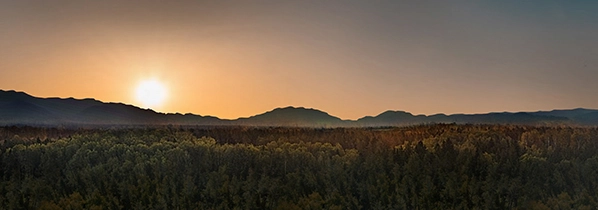
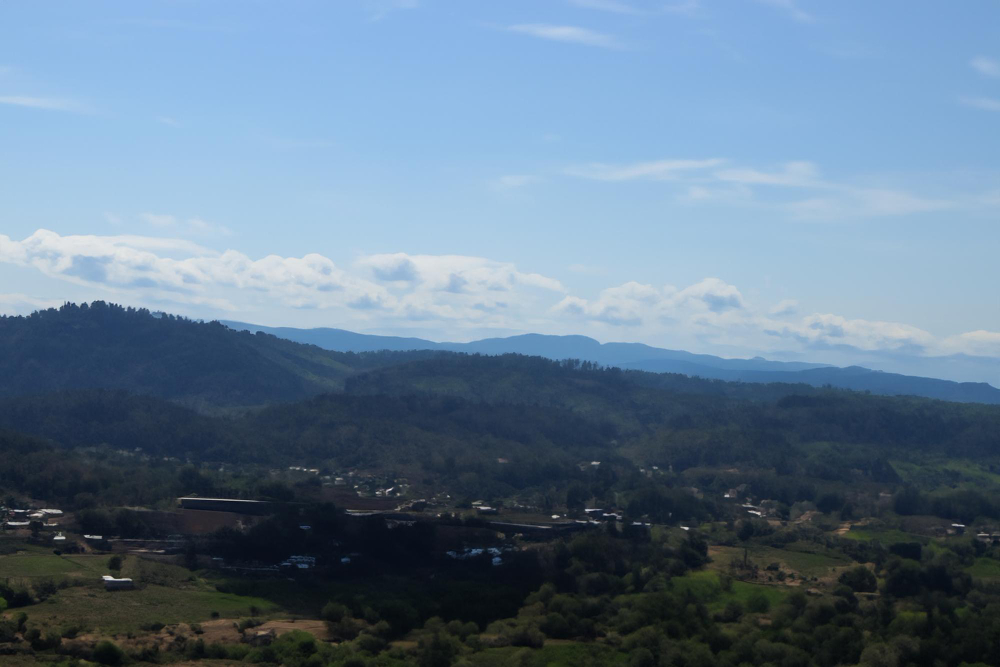
Stand at a window overlooking a densely packed urban block, and your eyes instinctively shift between immediate obstructions—a concrete wall, an overlooking balcony, a network of overhead wires. This constant adjustment forces a subtle but continuous cognitive strain. Now, stand before an uninterrupted horizon where the sky meets a rolling tree line. Your eyes settle, your shoulders drop, and your breathing slows. This shift is far more than an aesthetic preference; it is a profound biological transition.
In increasingly dense and overstimulated urban environments, visual openness has become a powerful contributor to emotional well-being and perceived quality of life. Modern homebuyers are recognising this reality. They are no longer evaluating properties purely by their physical dimensions or interior specifications. Instead, they are choosing emotional environments that dictate their stress levels, daily mood, and long-term psychological recovery. As premium residential planning evolves, the horizon itself is transitioning from a decorative backdrop into an essential element of human wellness infrastructure.
1. The Visual Exhaustion of Modern Cities
The contemporary Indian metro presents an environment of constant cognitive friction. As vertical density accelerates to keep pace with rapid urbanisation, our personal horizons are shrinking. The visual landscape has become highly fractured, dominated by dense skylines, overlapping structures, and severe visual clutter.
From a behavioural science perspective, this lack of spatial breathing room keeps the human nervous system in a state of low-grade alert. Environmental psychologists refer to this as "directed attention fatigue," a condition where the brain is perpetually forced to filter out irrelevant visual stimuli—traffic, glaring advertisements, and claustrophobic concrete barriers. The psychological compression of living in proximity to neighbouring structures creates a persistent sense of confinement.
Data from prominent property consultancies like ANAROCK reveal that lifestyle fatigue is driving a visible migration away from hyper-dense city cores. Homebuyers are looking to escape the sensory saturation of traditional concrete hubs, seeking out residential environments that offer a clear, uncompromised relationship with the sky.
2. Why Humans Respond to Open Views
The deep human need for visual openness is explained by evolutionary and environmental psychology. Roger Ulrich’s pioneering Psycho-Evolutionary Theory demonstrates that human beings are hardwired to seek environments that offer "prospect and refuge"—clear, elevated sightlines that allow for a wide view of our surroundings, balanced with a secure place of shelter.
Homes with open, uninterrupted views engage our parasympathetic nervous system, fostering recovery and rest. Through "soft fascination"—the effortless act of observing nature—we reduce stress and experience deep emotional comfort. These open sightlines go beyond visual space; they redefine a home’s emotional atmosphere, enabling natural mental decompression.
3. The Emotional Impact of Natural Landscapes
The type of view a home provides dictates the quality of emotional recovery its residents experience daily. While an open view of an urban highway offers spatial distance, it lacks the restorative capabilities of a view anchored by natural elements.
Research from the Journal of Environmental Psychology highlights a powerful truth: gazing upon natural wonders like rolling hills, lush treelines, and vast open skies triggers a much faster recovery from stress than looking at man-made structures. By prioritizing landscape integration, modern residential planning ensures that the healing power of nature is never more than a glance away.
When residents look out at natural surroundings rather than an adjacent concrete facade, their emotional recovery is measurably enhanced. The visibility of natural cycles—the shifting light of dawn, the movement of a seasonal canopy, or the silhouette of a mountain range—provides an anchor for mindfulness. This organic visual connection acts as a subconscious mental palate cleanser, mitigating the anxieties of a demanding professional life.
4. Open Horizons as a Luxury Marker
The definition of luxury in the Indian real estate market has evolved significantly. Historically, luxury homes in India were defined by material opulence—imported marble, gold-gilded fittings, and ornamental architecture. Today, luxury has pivoted from the ornamental to the experiential.
In a world where space and quiet are increasingly rare, a clear view has become the ultimate luxury commodity. High-net-worth individuals are evaluating developments based on their spatial comfort and visual privacy. A premium residence is no longer just about what is contained within the property lines; it is about the long-term protection of the airspace outside those lines.
True privacy is achieved when your home is not overlooked, and your sightlines remain uncompromised. This shift explains why a visionary real estate developer prioritises expansive site layouts over maximum vertical yield, recognising that an open horizon is a finite, uncopyable asset.
5. Residential Planning and Sightline Design
Preserving a sense of openness within a residential community requires meticulous master planning and highly deliberate site engineering. It cannot be left to chance.
Advanced architecture relies on explicit design principles to secure visual longevity for residents:
View Corridors: Designing roads and building orientations to align with external natural landmarks, ensuring that views are pulled deep into the interior lanes of the township.
Density Management & Setbacks: Increasing the distance between residential blocks far beyond structural mandates to protect mutual visual privacy.
Topographical Respect: Building in harmony with the natural slope of the land, allowing structures to step down naturally so that no building obscures the horizon of another.
By integrating these strategies, planners prevent the creation of claustrophobic residential pockets. The layout ensures that every window, balcony, and terrace functions as a portal to a wider landscape, protecting the community's emotional and spatial value for generations.
6. The Link Between Views and Property Value
There is a clear financial correlation between thoughtful sightline design and long-term asset appreciation. In the competitive real estate landscape of Panchkula and northern India, homes with protected views consistently command a premium.
A comprehensive market analysis by global firms like Knight Frank indicates that premium placement—properties boasting unobstructed natural vistas—secures higher transactional velocity and stronger resale value. Buyers demonstrate a clear willingness to pay a premium for properties that guarantee their view will not be obstructed by future construction.
This preference is deeply rooted in human emotion. While interior finishes can be easily upgraded or remodelled over time, the visual environment outside the building cannot be replicated. Consequently, developments that preserve their open views remain desirable across market cycles, thereby establishing a highly resilient asset class.
7. The Indian Urban Context
The need for visual decompression is amplified within India’s tier-1 and tier-2 cities. Rapid vertical expansion often results in a severe reduction of public green spaces and communal gathering areas. The typical urban resident spends their day navigating crowded commercial spaces, heavy traffic, and highly enclosed residential apartments.
This continuous exposure to confined spaces contributes to a collective lifestyle fatigue that directly impacts family wellness. As a result, the criteria for selecting the best housing society in Panchkula or the wider tri-city region have changed. Families are actively prioritising physical and emotional health, demanding residential environments that offer clean air, daylight, and an escape from the sensory confinement of dense concrete grids.
8. Why Integrated Townships Are Better Positioned
Traditional, standalone residential plots and high-rise clusters are fundamentally limited by their surrounding urban context; they cannot control the development of adjacent parcels. Integrated townships, by contrast, possess the scale required to curate, protect, and maintain an entire visual ecosystem.
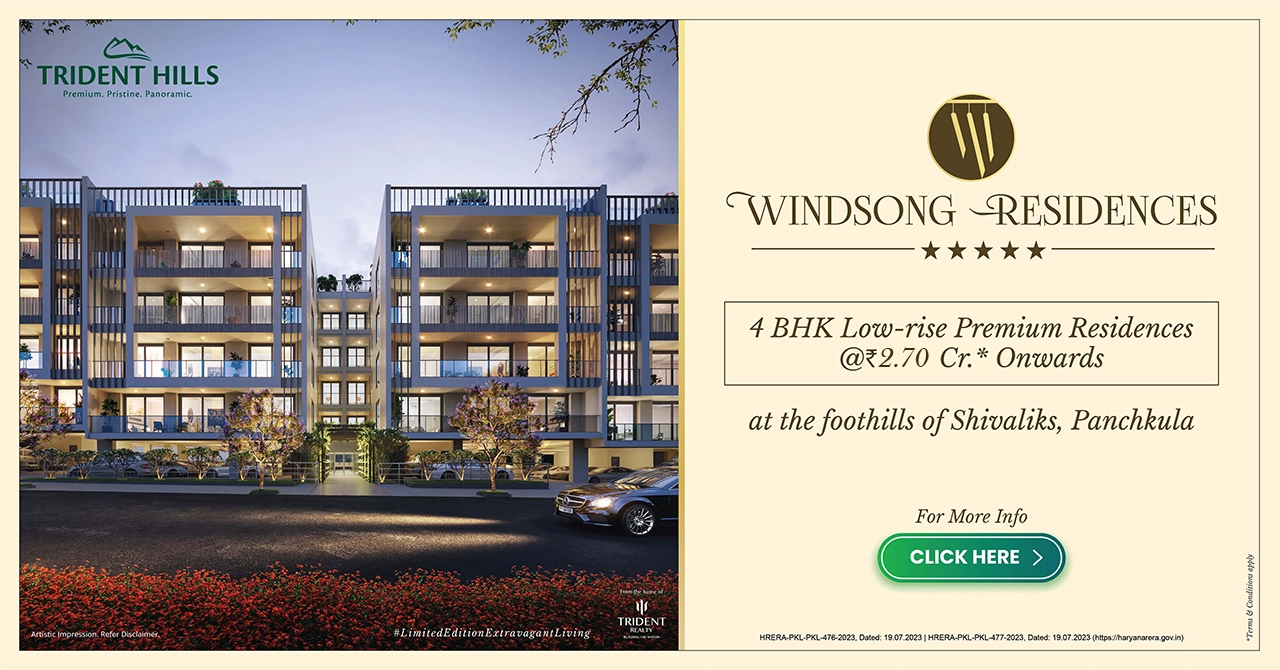
This macro-planning philosophy is clearly demonstrated at Trident Hills Panchkula, an ambitious 200-acre township master-planned by Trident Realty. Situated at the foothills of the Shivaliks, the development uses its natural geography to offer permanent, panoramic vistas of the hills, forest reserves, and the nearby Kaushalya Dam.
By capping vertical growth and focusing on low-density development, Trident Realty Panchkula ensures that the natural environment remains an active component of daily life. Whether a resident chooses an independent plot or a premium 3 BHK in Panchkula, the master plan secures their access to natural light and open air.
As prominent real estate builders in Chandigarh adapt to changing market dynamics, this landscape-conscious approach establishes Trident Hills as a forward-thinking sanctuary. It is an environment where the layout respects its residents' psychology, positioning it among the best societies in Panchkula for those prioritising holistic well-being.
Conclusion
The evolution of modern residential design demonstrates that the spaces we inhabit shape our inner well-being. The visual exhaustion of the modern city has proven that a home must provide more than physical safety; it must offer cognitive relief. True value in real estate is shifting away from surface-level ornamentation toward the deeper, restorative metrics of space, quiet, and visual freedom.
As we look toward the future of residential planning, the most desirable homes will not be defined by how effectively they shut out the world, or how high they rise above it. Instead, the ultimate luxury will belong to the homes that sit in harmony with the landscape—providing an enduring sense of openness, calm, and the infinite psychological comfort of an open horizon.