








What Makes a Neighbourhood Desirable 20 Years From Now?
A young couple visits a new residential neighbourhood. The entrance is immaculate, the clubhouse is newly furnished, and every sapling follows the landscape architect’s drawing. They can judge what it offers today. The harder question is: what will this place feel like when those saplings are mature, their parents need easier access, and the surrounding city has changed?
Twenty years is long enough for a fashionable façade to date, a road network to become congested and an expensive amenity to fall out of use. It is also long enough for thoughtful planning to prove its worth. Trees begin to shade streets properly. Local commerce settles into useful patterns. Social ties deepen. Infrastructure that was designed with adequate capacity continues to serve residents without recurring disruption.
Long-term desirability is therefore not the ability to predict the future perfectly. It is the capacity to accommodate change without losing everyday convenience, environmental comfort or a shared sense of place.
Desirability is a system, not a snapshot
Property decisions are often made from snapshots: a sample apartment, a launch price, the present travel time to work. A neighbourhood, however, behaves as a system. Homes depend on streets; streets depend on drainage and mobility networks; open spaces depend on water, maintenance and regular use.
This is why a swimming pool or smart access system says little about a neighbourhood’s prospects on its own. Can residents reach daily necessities without driving every time? Can the landscape cope with heat and heavy rain? Can common infrastructure be repaired efficiently? Will the community work for a six-year-old and a seventy-six-year-old?
India’s Ministry of Housing and Urban Affairs’ Liveability Standards reflect this wider view. They assess urban life through connected measures such as mobility, water, safety, public space, education and health. A durable neighbourhood needs similar breadth.
Location must be judged as a network
“Good location” is commonly used as though it were permanent. In reality, a location's practical value can change as employment centres evolve, transit corridors open, traffic volumes rise, and surrounding land is developed. A neighbourhood that depends on one arterial road or one distant business district may be convenient today yet vulnerable tomorrow.
The stronger proposition is connected location: more than one route, a sensible relationship with regional transport and proximity to daily services. Schools, healthcare, groceries and work opportunities need not sit at the gate, but should form a realistic network around the home.
Buyers should examine both the current map and the planning logic. Is proposed infrastructure officially notified or merely anticipated? Does access remain workable if one route is disrupted? What is planned on adjoining parcels? These answers will influence thousands of future journeys.
The neighbourhood should make room for different lives
Over two decades, the same home may serve new parents, teenagers, hybrid workers, visiting grandparents or an older couple living independently. At the neighbourhood scale, the resident mix will change too. A community designed around one narrow household profile risks becoming inconvenient as its population matures.
Adaptability begins inside the home: well-proportioned rooms, useful storage and spaces that can change function without major structural work. It must continue outside it. Step-free routes, shaded resting places, safe walking loops and legible wayfinding allow more people to use the community confidently.
Universal design matters because it is easy to postpone and expensive to retrofit. A gentle gradient, a sufficiently wide doorway, or a conveniently placed handrail may seem incidental at purchase. After an injury, during pregnancy or in later life, it becomes central to independence. A desirable neighbourhood does not segregate these needs into a special corner; it makes everyday movement naturally inclusive.
Climate resilience will become ordinary liveability
A landscape can look green in a brochure and still perform poorly in summer. Long-lived communities need planting and water systems selected for local conditions, not visual effect.
In reality, a location's practical value can change as employment centres evolve, transit corridors open, traffic volumes rise, and surrounding land is developed. A layered tree canopy can reduce glare and make walking plausible during warmer months. Permeable surfaces, thoughtfully graded streets, rainwater management and protected natural drainage paths help the ground handle sudden downpours. Building orientation, external shading and ventilation influence how much mechanical cooling homes require.
These decisions determine comfort, operating demand and the frequency of disruption. The IGBC Green Townships Rating System accordingly evaluates site selection, land use, transportation, and infrastructure resource management together. IGBC indicates that well-executed strategies can reduce energy demand by 20–30% and water demand by 30–50%. The lasting value depends on whether the systems are commissioned, monitored, and maintained.
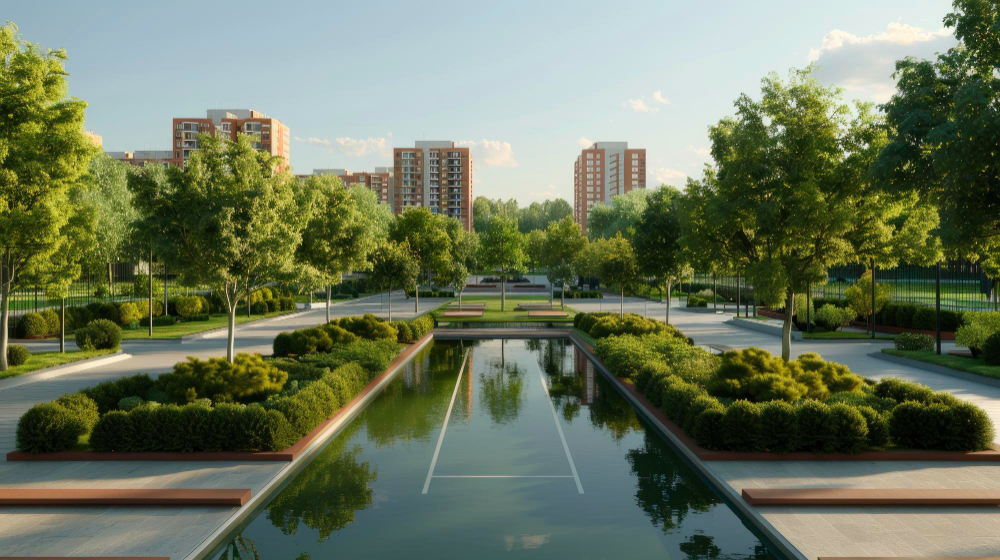
Mature landscape can become one of a neighbourhood’s greatest assets, but only when it is given enough soil, water and room to grow. A neighbourhood’s long-term landscape quality is rooted in decisions made before the first tree is planted.
Infrastructure must be maintainable, not merely adequate on day one
The least photographed parts of a development often carry the greatest long-term responsibility: water treatment, power distribution, waste handling, drainage, fire systems and service access. Capacity matters, but so does maintainability.
Equipment will age. A robust plan anticipates this through sensible access, documented specifications, replaceable components and clear responsibility for upkeep. Technology should help operators detect leaks and respond quickly; it should not make essential services dependent on one vendor.
Prospective buyers can ask practical questions. What is the water source and treatment plan? How is storm water separated from sewage? What provisions exist for changing waste volumes, electric-vehicle charging demand and other future utility requirements? Who manages the community after handover, and how are lifecycle costs budgeted? Maintenance charges that appear unusually low may simply transfer today’s savings into tomorrow’s failure.
A neighbourhood ages well when renewal is planned before deterioration becomes visible.
Everyday proximity matters more as cities expand
The value of a neighbourhood is experienced in minutes as much as in square feet. A ten-minute errand that repeatedly takes forty minutes imposes a quiet cost on family life. As Indian cities spread outwards, communities that reduce unnecessary travel can offer greater everyday convenience and resilience to changing mobility patterns.
This does not require placing every function inside a gated enclave. It requires homes safely connected to useful open spaces, routes that lead somewhere, convenient access to daily services, and comfortable links to wider transport. The IGBC Green Cities framework promotes integrated planning approaches that encourage efficient land use, sustainable mobility and greater access to walking, cycling and public transport.
Good proximity also creates choice. A child may walk to play, an older resident may reach a garden without assistance, and a household may complete a small errand without starting a car. That freedom remains valuable even as amenity fashions change.
Governance determines whether good design survives.
Architecture establishes possibility; management determines whether it endures. A beautifully designed park can become unusable if repairs are delayed. A water-saving system offers little benefit if no one monitors it. Opaque or inconsistently applied rules can erode trust faster than physical wear erodes buildings.
Long-term community performance therefore benefits from transparent budgets, adequate reserves for major repairs, responsive facility management and appropriate opportunities for resident participation. Design controls can protect neighbourhood character, but must allow reasonable evolution.
This layer cannot be staged in a sales gallery. Yet buyers perceive its results immediately—in shared-space condition, service reliability and the confidence with which residents describe their community.
Character should deepen rather than be manufactured
The most valued neighbourhoods eventually acquire memory. A grove becomes a morning meeting place; children learn to cycle along the same shaded route. Such patterns cannot be installed like equipment, but planning can enable them.
Human-scaled streets, recognisable landmarks and a considered relationship between buildings and landscape give residents the raw material for belonging. The aim is not novelty at every turn, but enough identity to be memorable and enough flexibility to let residents make the place their own.
For Trident Realty, this longer view extends responsibility well beyond delivering individual homes. A focus on sustainability, well-being and customer-centric development becomes most meaningful when these principles are reflected in planning decisions that continue to serve residents long after possession.
A buyer’s twenty-year test
No buyer can inspect the future, but a site visit can reveal whether you've considered it. Look beyond polished surfaces and ask:
How will access change as the surrounding area develops?
Can people of different ages move through the community safely and independently?
Are landscape and water systems suited to the local climate?
Is essential infrastructure accessible, replaceable and adequately funded?
Do walking routes connect homes to places people genuinely use?
Is there a credible structure for maintenance and resident participation?
Can homes and shared spaces adapt as households and work patterns change?
These questions do not produce a guaranteed financial outcome; no responsible assessment can. They do, however, reveal qualities that can contribute to long-term liveability: usefulness, resilience, care and identity. A neighbourhood that remains relevant in twenty years will not necessarily preserve its launch-day appearance unchanged.
Explore Trident Realty to discover a development philosophy shaped around enduring communities, thoughtful planning and better everyday living.